Coadan:Accretion disk.jpg
Jump to navigation
Jump to search
Size of this preview: 750 × 600 pixels. Other resolutions: 300 × 240 pixels | 600 × 480 pixels | 960 × 768 pixels | 1,280 × 1,024 pixels | 2,560 × 2,048 pixels | 3,000 × 2,400 pixels.


Jeeskeaylley ymlane (3,000 × 2,400 phixel, mooadys y choadan: 679 KB, sorçh MIME: image/jpeg)

Giare-choontey
| Coontey |
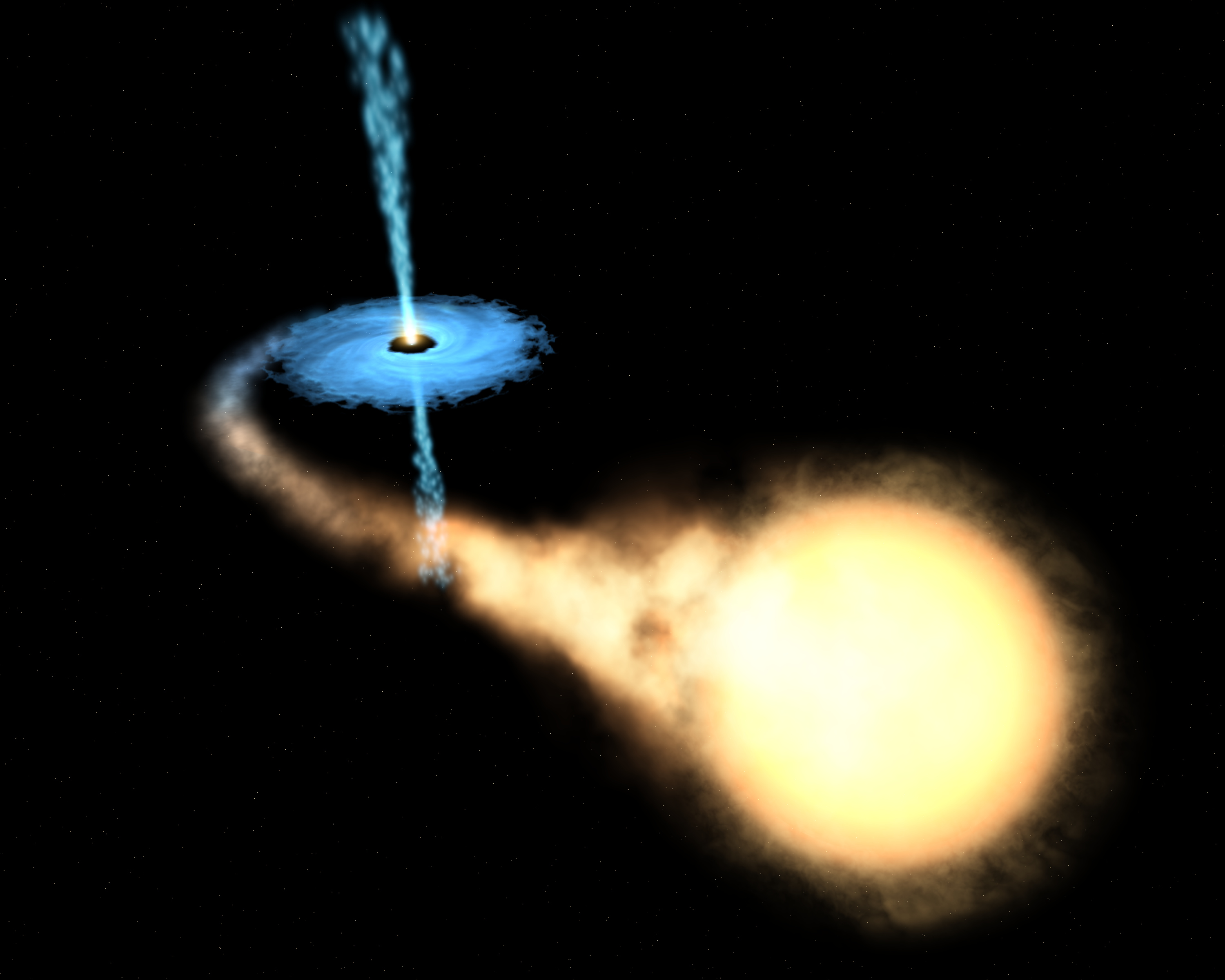
English: Artist's rendition of a black hole with an orbiting companion star that overflows its Roche lobe. Mass from the companion star is drawn towards the black hole, forming an accretion disk.
GRO J1655-40 is the second so-called 'microquasar' discovered in our Galaxy. Microquasars are black holes of about the same mass as a star. They behave as scaled-down versions of much more massive black holes that are at the cores of extremely active galaxies, called quasars. Astronomers have known about the existence of stellar-mass black holes since the early 1970s. Their masses can range from 3.5 to approximately 15 times the mass of our Sun. Using Hubble data, astronomers were able to describe the black-hole system. The companion star had apparently survived the original supernova explosion that created the black hole. It is an aging star that completes an orbit around the black hole every 2.6 days. It is being slowly devoured by the black hole. Blowtorch-like jets (shown in blue) are streaming away from the black-hole system at 90 percent of the speed of light. |
| Date | (released) |
| Bun | https://science.nasa.gov/asset/hubble/artists-view-of-black-hole-and-companion-star-gro-j1655-40 |
| Author | ESA, NASA, and Felix Mirabel (French Atomic Energy Commission and Institute for Astronomy and Space Physics/Conicet of Argentina) |
Kieddagh:
  |
ESA/Hubble images, videos and web texts are released by the ESA under the Creative Commons Attribution 4.0 International license and may on a non-exclusive basis be reproduced without fee provided they are clearly and visibly credited. Detailed conditions are below; see the ESA copyright statement for full information. For images created by NASA or on the hubblesite.org website, or for ESA/Hubble images on the esahubble.org site before 2009, use the {{PD-Hubble}} tag.
Conditions:
Notes:
|
.jpg) |
This file is licensed under the Creative Commons Attribution 4.0 International license.
Attribution:
ESA/Hubble
- You are free:
- to share – to copy, distribute and transmit the work
- to remix – to adapt the work
- Under the following conditions:
- attribution – You must give appropriate credit, provide a link to the license, and indicate if changes were made. You may do so in any reasonable manner, but not in any way that suggests the licensor endorses you or your use.

|
This file, which was originally posted to
Hubble Site, was reviewed on 17 May 2020 by reviewer Green Giant, who confirmed that it was available there under the stated license on that date.
|
Shennaghys y choadan
Crig er daayt/am ennagh son fakin er y choadan myr v’eh ec y traa shen.
| Daayt/Am | Ingin-ordaag | Towshanyn | Ymmydeyr | Cohaggloo | |
|---|---|---|---|---|---|
| bio | 16:17, 26 Averil 2019 | | 3,000 × 2,400 (679 KB) | wikimediacommons>FriedrichKieferer | Better quality. |
Ymmyd y choadan
Ta ny 1 duillag eiyrtyssagh kianglt rish y choadan shoh:
